The Future of AI Trading Interfaces Is Not Another Dashboard
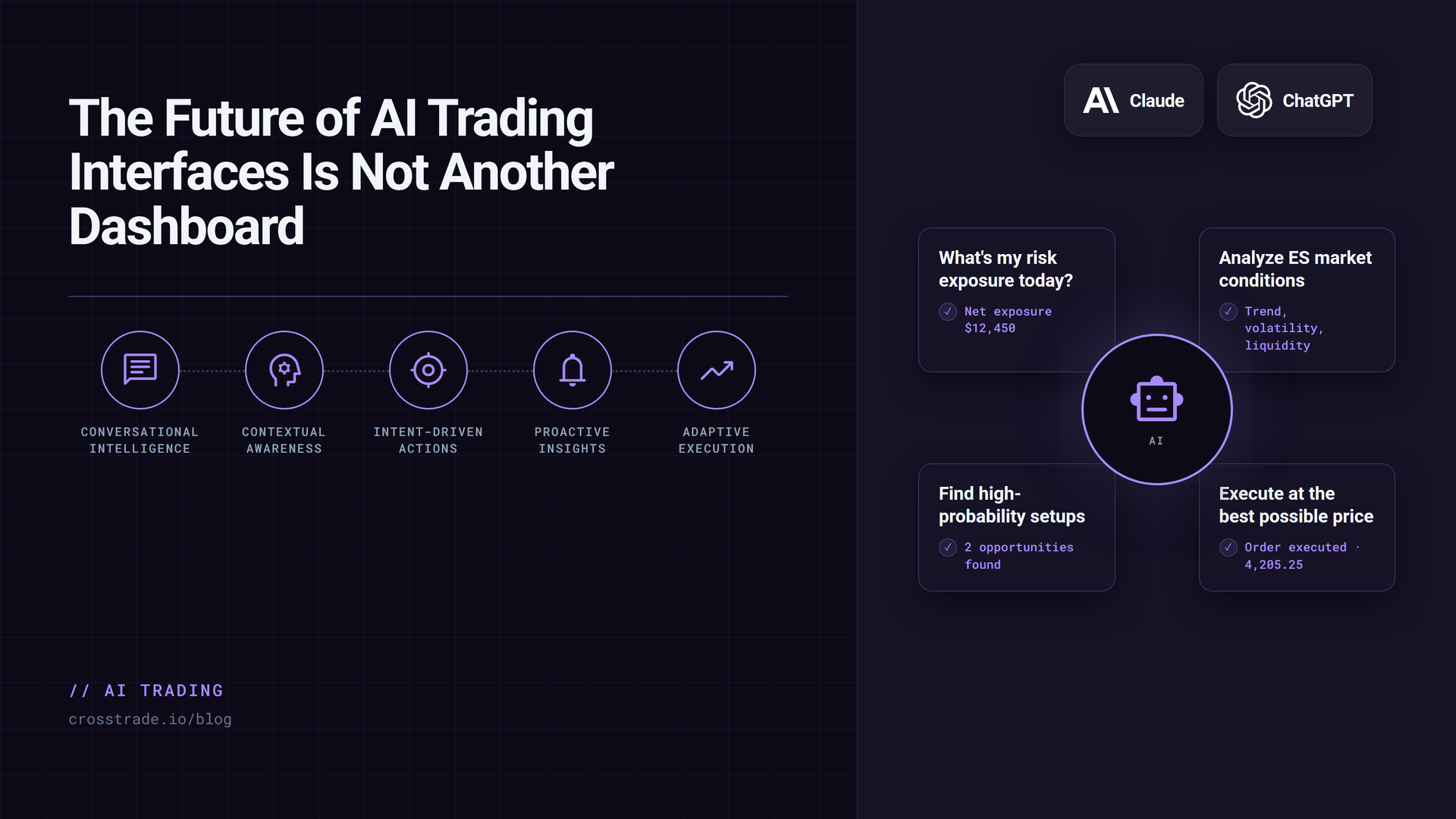
Dashboards show state. They do not answer cause. The AI trading interfaces that matter most are not dashboards. They are conversations grounded in real account data.

Trading dashboards have been the default interface for two decades. They show state. Account balance, open positions, working orders, P&L, recent fills, charts. A well-built dashboard can communicate a lot in a small space, and traders are very good at reading them.
The limit is the next question. A dashboard tells you that you are down $180 today. It does not tell you which trade started the slide, whether the loss came from a single bad fill or three small ones, or whether the slide is correlated with a time of day where your setup never wins. To get those answers, you leave the dashboard. You open a spreadsheet. You scroll the journal. You give up.
Dashboards are good at showing state, not answering cause
The shape of a dashboard is "render the world as it is right now." The shape of cause is "stitch together what happened over a window and identify the pattern." Different problem. Different interface.
For two decades there was no alternative. The data was scattered across three systems. Manual correlation took an hour. Most traders never bothered.
Agents are good at correlation, explanation, and repetitive workflows
An MCP agent connected to CrossTrade can pull the matched-trade journal, the TradingView webhook signal history, the CrossTrade Add-On activity log, and the per-account orders and executions in a single conversation. It can answer the next-question questions:
- "What was different about my biggest loser today?"
- "Why did the follower account miss the leader's fill at 14:32?"
- "Did the strategy I deployed last week have positive expectancy this week?"
- "How close did I come to the firm's daily loss limit?"
None of those questions have a clean dashboard widget. All of them have an obvious answer if the right four data sources are read together. That is what agents are good at.
Where chat helps
- Post-session review. The agent reads everything and produces the summary you would build manually.
- Diagnostics. The agent walks the chain from signal to fill and points at the gap.
- Pre-trade checks. The agent computes daily loss room against the firm's rule and refuses trades inside a buffer.
- NinjaScript compile loop. The agent writes, compiles, repairs, and writes the file.
- Strategy decay tracking. The agent buckets recent trades and tells you whether expectancy is fading.
Where chat is dangerous
Chat is dangerous when the user mistakes the agent's confidence for accuracy. The model will produce plausible answers to wrong questions. The defenses are the ones we keep coming back to: typed tools, OAuth scope, state checks, confirmation gates.
Chat is also dangerous when the conversation drifts into autonomous trading. Trade-enabled scope plus a soft prompt is the worst-of-both-worlds: the agent can act, but it does not have to wait for you. The right pattern is trade-enabled scope plus a strict prompt that requires explicit confirmation on every write.
The hybrid model
The interface that wins in the next few years is not "dashboard" or "chat." It is both. The dashboard renders state cleanly. The chat agent answers the questions the dashboard cannot.
Practically: keep your NinjaTrader UI open. Keep your CrossTrade dashboards open. Keep Claude Desktop or Claude Code open. The first two are for showing what is. The third is for asking why.
CrossTrade's direction
CrossTrade does not need to replace your dashboard. We need to be the layer that makes the chat agent useful: the add-on that bridges to NT8, the journal and webhook and copier history that let the agent explain, the typed MCP tools that let the model do the work without writing HTTP, the scopes that keep it safe.
Long term, the dashboards and the agent surface should reinforce each other. A chart that shows your watermark on hover. A chat agent that can explain the watermark with a sentence. The two together are what the next ten years of trading interface looks like.
Link to the hub
The MCP hub is the entry point. Start with a read-only journal review. Build trust with inspection workflows. Add scope and confirmation gates when a workflow earns the upgrade.
Dashboards are not going away. The agent is the part that was missing.